
Make story time a moment that brings you closer
When your child is the hero, the story becomes theirs, and they want to talk about it. A few simple habits help you make the most of it and turn those pages into a real conversation, just the two of you.
This guide works for all our stories. Each book also has its own parents’ guide inside, written for that story.
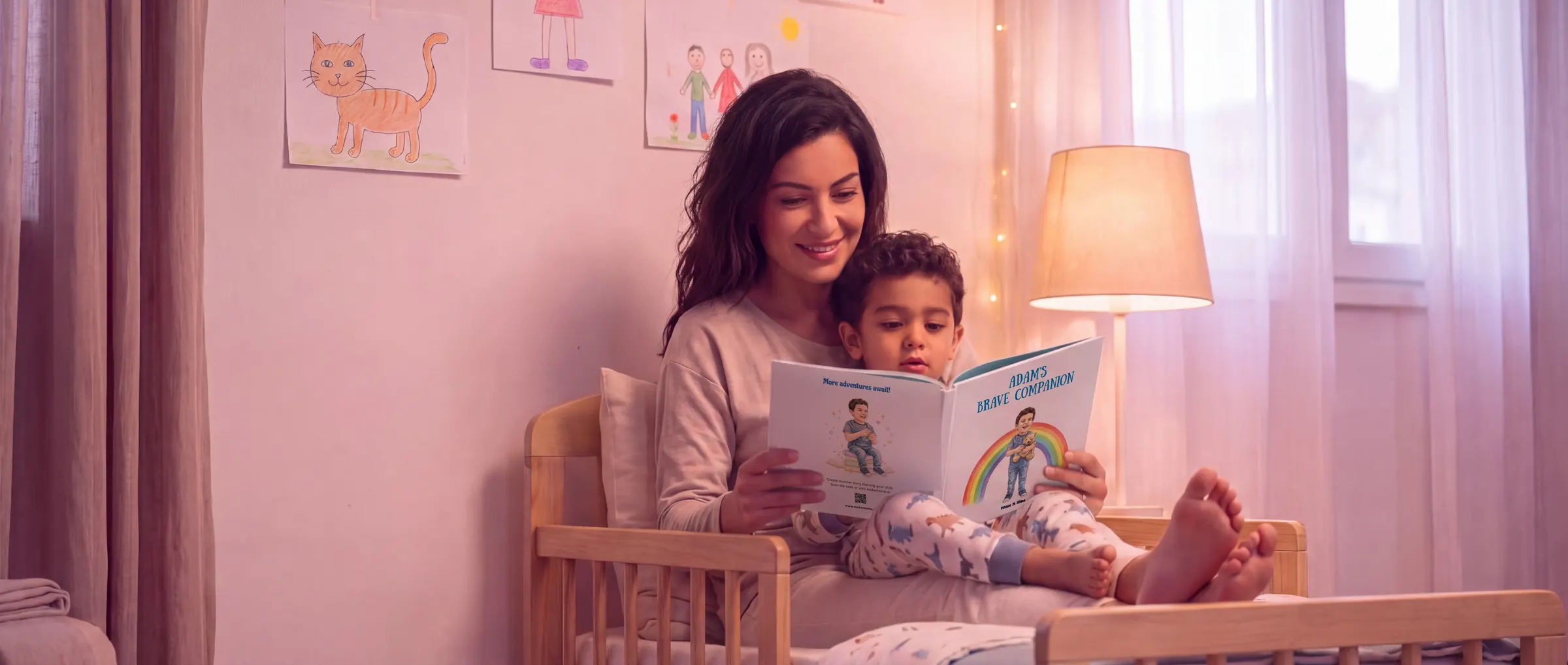 Photo created with AI
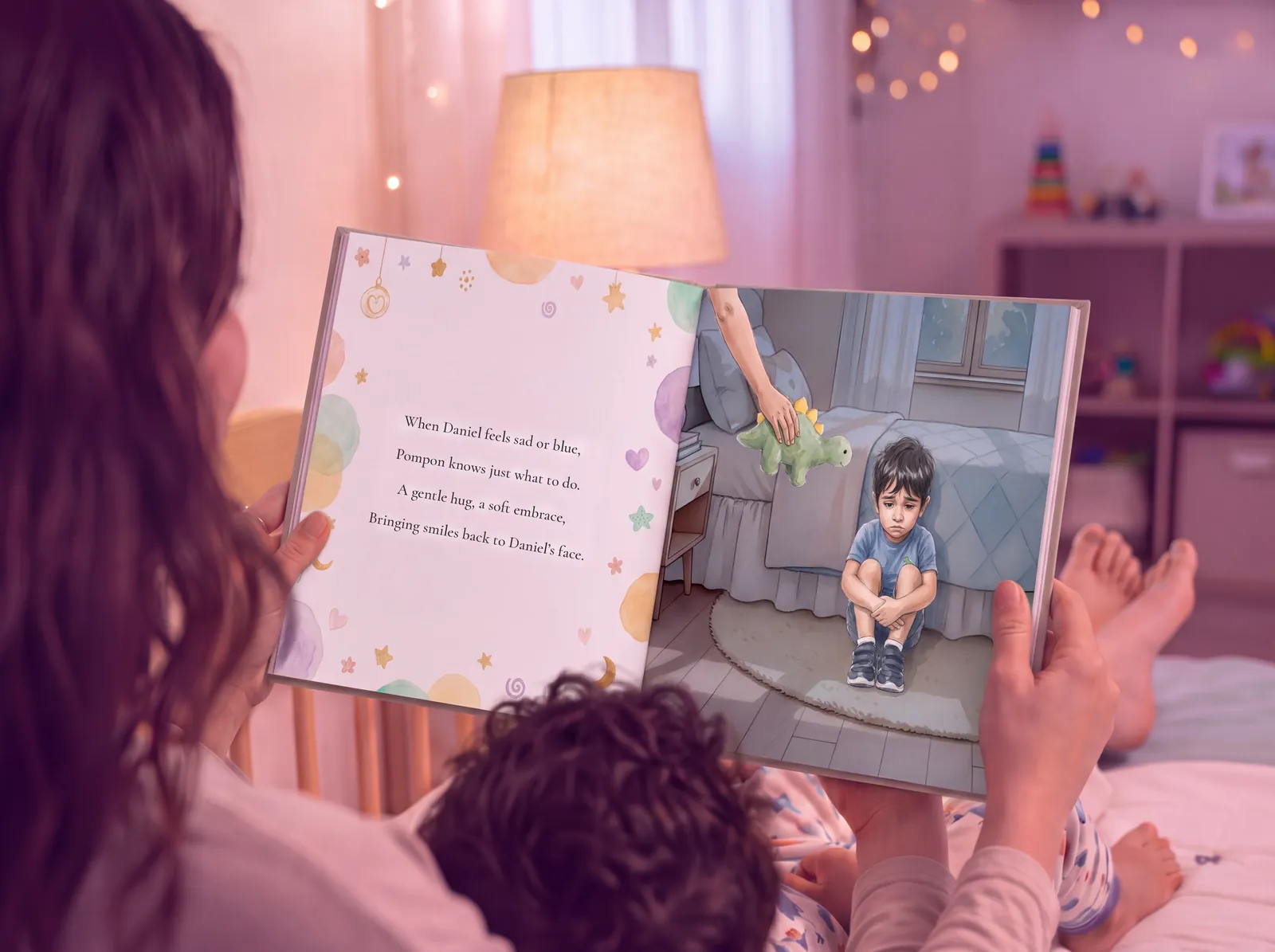 Photo created with AI
While reading: 4 habits
You ask, your child answers, you repeat the answer and add to it. Researchers call it dialogic reading. Find your child’s age:
Ages 2 to 3
- Point and name
“Look, it’s your plush toy! So soft.” - Ask simple questions
“Where’s your toy?” “And you, in the picture, are you happy or sad?” - Repeat and add a word
“Yes, your teddy. Your soft brown teddy.” - Let them join in
Turning pages, touching, making the sounds. Leave the last word of a rhyme for them to say.
Ages 4 to 6
- Pause
Stop on a picture that catches their interest. - Ask an open question
“What’s happening here?” rather than “Is that your toy?” - Repeat and add
“Yes, you look sad. You lost your plush toy.” - Link it to their life
“Has that ever happened to you?”
Ages 7 to 8
- Take turns reading
One page each, or they read the toy’s lines out loud. - Ask why
“Why do you think you felt like that here?” - Guess what comes next
“What would you do now?” Then turn the page and compare. - Link it to their week
“Did something like this happen at school?” Listen first, advise later.
Based on dialogic reading (G. Whitehurst and colleagues, from 1988; the PEER and CROWD approaches), mostly studied between ages 2 and 5. For ages 7 to 8, the same idea carries on as a conversation about the story.
Talk about the hero’s feelings, then your child’s
Children often find it easier to talk about how a character feels than about how they feel. So start in the book, with the hero, then use the same words when it happens for real. Four feelings are enough to begin with: joy, sadness, fear and calm.
| Step | While reading | In real life |
|---|---|---|
| Name it | “Look at your face in the picture. Do you think you’re sad there?” | “You look sad.” |
| Welcome it | “It’s normal to be sad when you’ve lost your toy.” | “It’s OK to be sad. I’m here.” |
| Find what helps, together | “What could help you there, in the story?” | “What would feel good? A cuddle, your toy?” |
Avoid: “It’s nothing”, “Stop crying”. They come from a good place, but they tell the child their feelings don’t count. Try instead: “That was a big feeling. I’m here.”
Before you open the book and after you close it
Before
- Pick the same moment each day, often at bedtime, so the story becomes a ritual they look forward to.
- Find a cosy spot, with screens off and time to spare.
- Let them bring their plush toy or favourite toy. It can listen too.
- Let them choose the book, even if it’s the same one again.
After
- If the last page asks a question, ask it and simply listen: there is no right or wrong answer.
- Tell them about you at their age: “I had a teddy bear too, and thunder scared me.”
- Another day, act out a scene with their toys or draw it together. Keep the scary scenes for the daytime.
- If a line from the book becomes their favourite, say it together at the matching moment of the day, the same way each time.
- Read it again whenever they ask. Children love a story they know, and each time there’s something new to talk about.
How our books are made
Developed with a psychologist
Every book is thought through and reviewed with a psychologist, so it’s fun to read and made to help your child with the everyday challenges of growing up, and the ones life puts in their path. The psychologist also makes sure the words are right for your child’s age.
Your child is the hero
Their name and their face in every illustration: the story is theirs, and they recognise themselves in it. One small study found that children around age 3 talked more, unprompted, while reading a personalised book*. A lovely way in to talk about what they’re going through.
A parents’ guide with every book
A QR code in each book gives you access to a guide made for that story, full of simple ideas to bring it into your everyday life. Choose the challenges from the book that matter to you right now and discover tips and strategies to better support your child.
* N. Kucirkova, D. Messer and K. Sheehy (2014), “The effects of personalisation on young children’s spontaneous speech during shared book reading”, Journal of Pragmatics, 71, pp. 45-55.
Common questions
My child can’t sit still while we read.
That’s common, especially before age 4. Read a few pages, let them move, act and point. The time together matters more than finishing the book.
They want to skip pages.
Let them choose. They often go back to a page that touches them: a good chance to talk about it.
What if the story stirs up a fear?
Take time to talk and accept the fear. Take a break if needed. If a fear lasts several weeks or you are worried, talk to the nursery or school staff, or your paediatrician.
When should we start reading together?
From the first months, looking at pictures together and naming them is a moment for two. Each book’s page gives the ages it is written for.
Ready for a story where your child is the hero?
Choose a storyNothing to pay until you've approved the drawings.